
Macro Math without the B.S.
Grams, calories, ounces & macros—what’s the difference, really?

Calories, macros, grams, ounces. What’s the difference, and does it actually matter?
If you’ve ever tried to track your food and felt totally lost in the swirl of numbers and nutrition lingo, you’re not alone. Why do some people count macros while others just track calories? And where do the grams come in?
The overlap can get confusing. It’s kind of like stepping into a new gym. You’re motivated to start until you see things like HSPU or AMRAP and realize you have a new language to learn before the workout even begins.
Same idea here. The terminology isn’t that complicated, but if no one has ever explained it clearly, it’s easy to stay stuck. Today we’re breaking down calories, macros, grams and ounces, how they relate, and how this information actually applies to your nutrition journey.
Learning the Lingo
What are calories?
Calories fuel your body. Technically speaking, a calorie is defined as the amount of heat needed to increase 1 gram of water by 1 degree Celsius. But, in terms of nutrition calories are a measure of the energy value of the foods and drinks we consume [1].
Simply put, calories equal energy and your body needs a certain amount of energy to sustain basic functions.
Counting Calories for Weight Loss or Performance Gains
Your total daily calorie consumption is specific to your sex, age, activity level, genetics, and more.
Generally, calorie balance is achieved when you take in the same amount of calories through food and drink as you exert through daily and physical activities including organized exercise, NEAT and other metabolic processes. Adjusting calorie balance determines if you are in a caloric deficit or surplus.
Counting calories can be a helpful place to start in your nutrition journey but it does not account for the type of nutrients you are consuming.
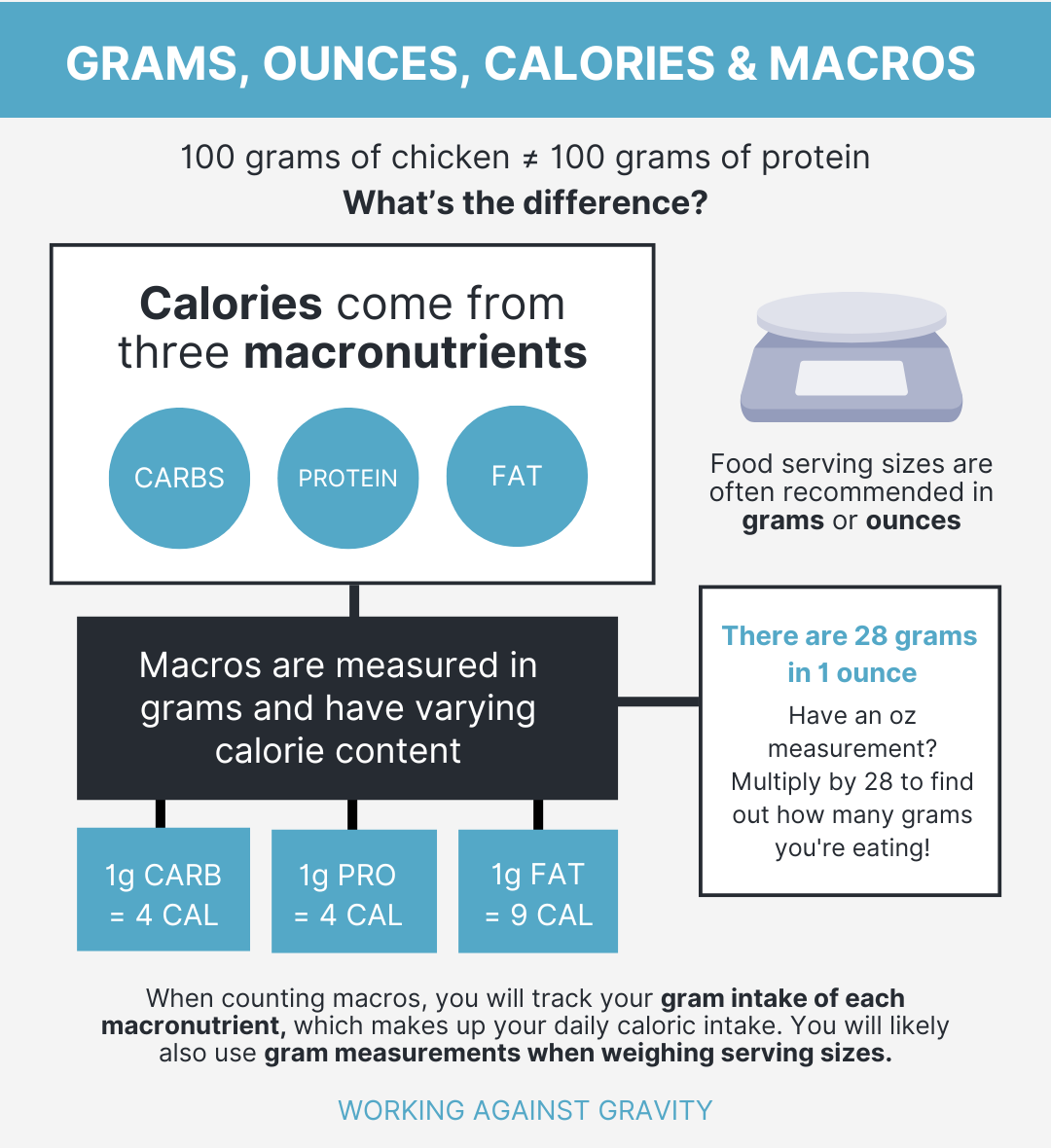
Calories are made of macronutrients (macros).
How are Macronutrients Different Than Calories?
The three macronutrients (aka, “macros”) are protein, carbohydrates, and fats. The body requires macronutrients in relatively large amounts [2]. They make up the bulk of your diet and supply your energy as well as essential nutrients [2]. Knowing the difference between each macronutrient can help you understand how each impacts your fitness goals.
What are carbohydrates?
Carbs are a single sugar unit that provide short-term energy. They are your body’s first choice for fuel. Carbohydrates are stored and used in two places: (1) as glycogen in your liver to maintain blood sugar, and (2) in your muscles to fuel exercise. The more active you are and the more muscle you have, the more carbs you need.
What is protein?
Protein is made of a combination of 22 amino acids (both essential and nonessential) and makes up your muscle, skin, hair, nails, eyes, and internal organs. Your body can make nonessential amino acids but you need to get essential amino acids from the foods you eat.
Your body relies on protein for fuel only in an emergency (when carbs are low). Protein consumption is crucial because your body cannot produce some of the essential amino acids on its own, it must get them from food sources. Protein is also important because it is responsible for muscle growth, healing from illness, and cell recovery. Athletes especially must consider the amount and quality of protein consumption to meet nutrient needs [3].
What are fats?
Fats facilitate the transport and absorption of vitamins such as A, D, E, and K. Omega-3 fatty acids support joint health, digestion, brain function, and cardiovascular health [4]. Fats also support healthy hormone production.
Fats digest slowly so they keep you fuller, longer and are a great long-term energy source for your body.
Balancing your Macros
To ensure your body gets everything it needs for proper fuel and function, you need to consume a balance of each macronutrient. Each macronutrient contains micronutrients (vitamins and minerals). There are six essential micronutrients including vitamin D, iron, zinc, vitamin A, folate, and iodine, all found in the foods we eat [6]. When you eat too much of one macronutrient and not enough of another, you can miss out on important micronutrients.
It’s important to keep in mind that “balance” doesn’t mean the exact same amount of each. It means a combination of the three macronutrients in a ratio unique to you, your body, and your unique goals.
Macros and your goals
No matter what your goal is, there is a ratio of macros that will support it, and counting macros versus calories is paramount to achieving fitness-related goals.
Exact numbers differ from person-to-person which is why working with a nutrition coach who gets to know you, your goals and your body is a game-changer!
Here are some general things to keep in mind that may help you narrow down what your body needs:
Endurance athletes may need a more even blend of carbs and fat so you have immediate and sustained energy in the tank.
Functional fitness athletes may need a few more carbs since they provide a quicker energy source than fats.
Weightlifters may need more protein to account for increased protein breakdown during and immediately after exercise. Protein breakdown and building is higher after resistance training. In order to build muscle, the body needs to store more protein than it is using as fuel - this is called being in “positive nitrogen balance”.
Those trying to lose weight will need a caloric deficit and a varying balance of macronutrients based on daily activity level. Research shows that distribution of macronutrients impacts weight loss and that intake recommendations should be based on individual circumstances [3], such as gender and DNA for example.. Accounting for the balance of protein and carbohydrates in daily caloric intake improves overall weight management [3].
Each macronutrient is imperative to your diet and to your body’s performance. Progress comes from consuming the correct amount of each macronutrient for your goals, characteristics, and circumstances.
So our food contains calories, which contain macronutrients that should be consumed in the correct goal-dependent ratio. Got it. Next up: grams, or how much of each macronutrient you consume.
Grams and Your Goals
Grams are a unit used to describe the caloric density of each macro. You’ll hear this used like, “I eat 150 grams of protein per day.”
Each gram of a given macronutrient is equivalent to a specific number of calories.
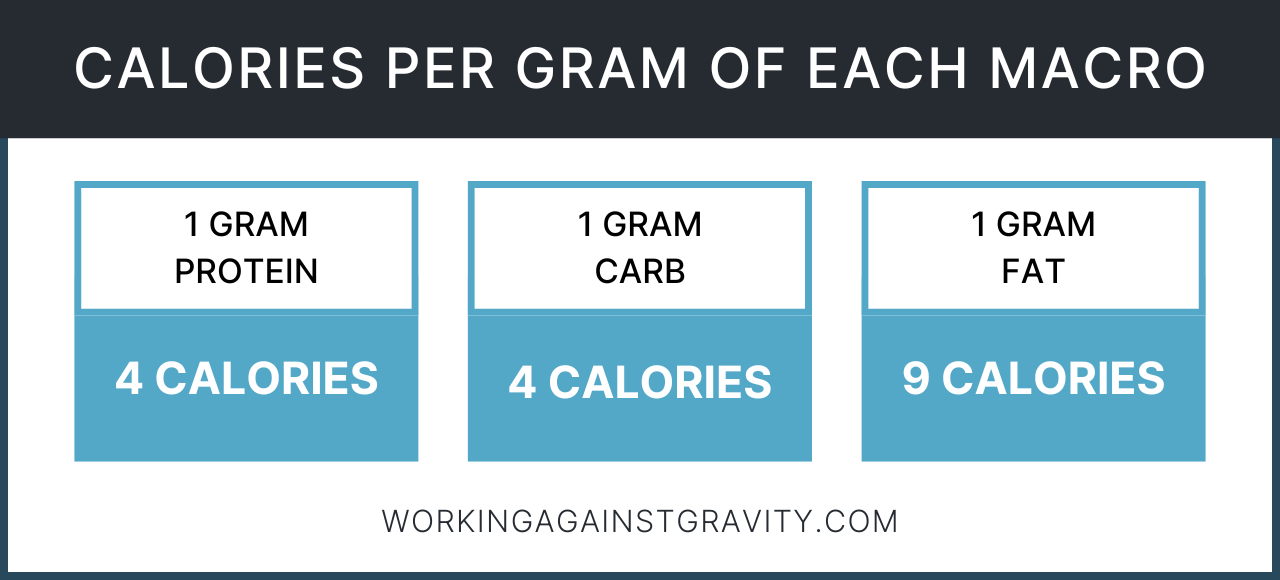
Putting this into practice, the 150 grams of protein mentioned above would equal about 600 calories of protein each day. If the same person had a 200 gram carbohydrate goal and a 60 gram fat goal, we could find their total calorie goal with a little multiplication:
150 grams of protein (x4) = 600 calories
200 grams of carbs (x4) = 800 calories
60 grams of fat (x9) = 540 calories
Total: 1940 calories
Measuring Your Food Intake
This is where it’s easy to get confused, because we’re going to talk some more about grams — but this time, we’re referencing the weight of your food. Grams and ounces are units of measurement most commonly used to determine a food’s serving size. But this does not mean that 1 gram of weight = 1 gram of a micronutrient.
Sorry, we aren’t the ones who decided to use the same unit word for both, but here we are.
One more time for clarity:
The food you eat contains calories that can be divided into grams of macronutrients.
How much of any food you eat can be measured by its weight in grams or ounces.
Since grams and ounces are both units of weight, they can be used somewhat interchangeably. There are 28 grams in every ounce.
There are also volume measurements, such as cups and spoons, but the weight of your food is a much more accurate representation of your intake. Since your progress is directly tied to accurately consuming the correct amount of each macronutrient, we strongly recommend measuring your food on a food scale.
Let’s put this all together on a nutrition label!
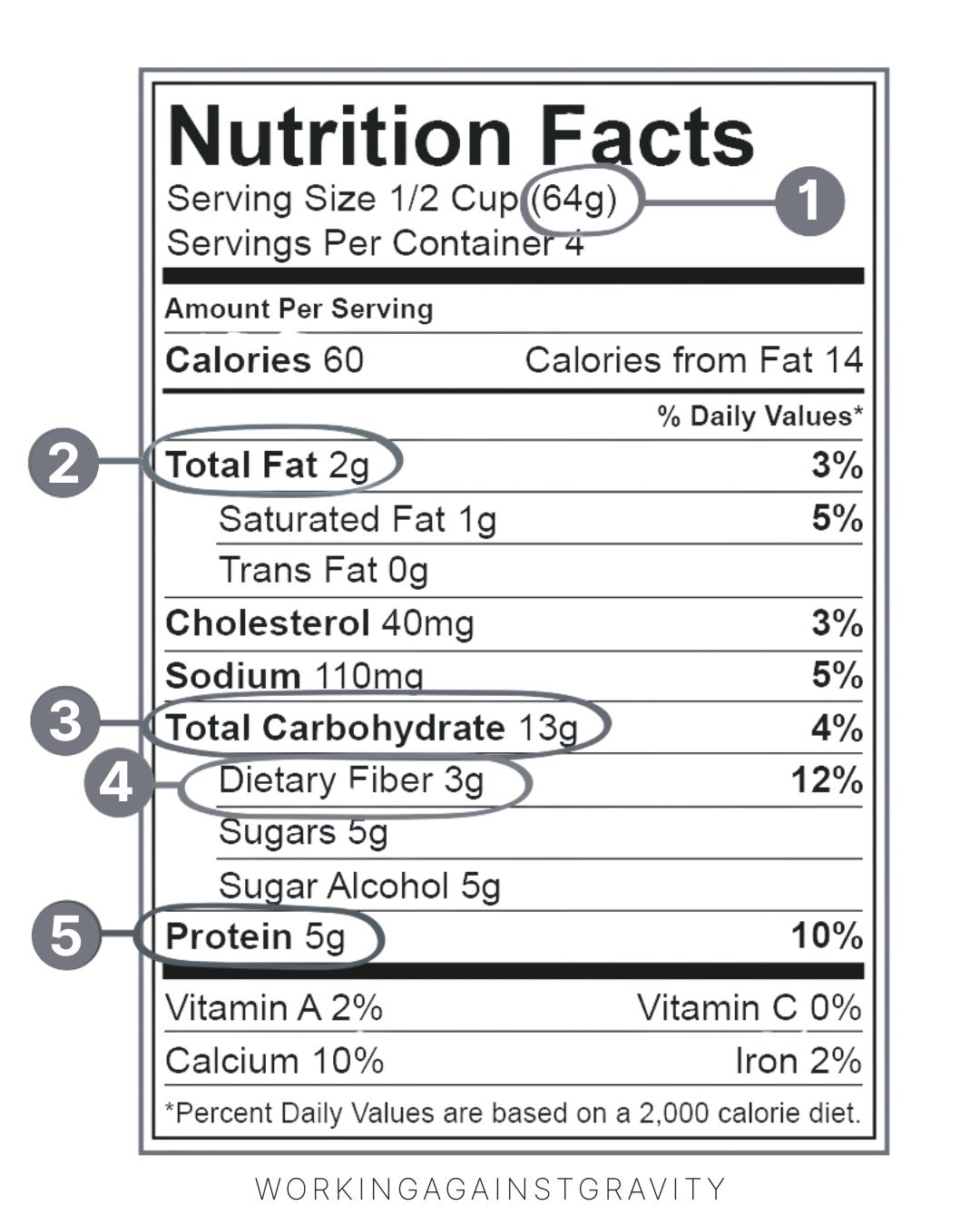
Here’s a breakdown of what you see:
Serving size in grams. We recommend using grams vs. cups/spoons if you’re trying to be as accurate as possible.
Amount of fat in this food.
Amount of carbs in this food.
Amount of fiber in this food.
Amount of protein in this food.
It’s important to note that a label will give you the weight in grams or ounces but rarely both. With a little multiplication (and remembering that there are 28g in 1oz), you can figure out how many grams your food weighs even if you’re only given ounces on your nutrition label.
For Example: Total grams in 4oz = 4oz x 28g/oz = 112g
One of the easiest ways to keep track of your food and food measurements is by using a food tracking app like MacrosFirst or MyFitnessPal. Check out the Complete Guide to MyFitnessPal Tutorials to jumpstart your expert-level tracking.
Whether you need to be as precise as possible to reach your current goal or you’re practicing your flexibility, learning the lingo is an important step in your weight loss and fitness journey.
It can be difficult to piece the information together, let alone put it into practice. We get the challenge, and this is where one-on-one nutrition coaching with WAG can come in handy. A WAG coach can work with you to determine your personalized macro breakdown based on your specific goals, and help make sense of the confusion as you get started.
References:
Centers for Disease Control and Prevention (n.d.). Session 7: Tip the calorie balance. https://www.cdc.gov/diabetes/prevention/pdf/handout_session7.pdf
Youdim, A. (2019, May). Overview of nutrition. Merck manual professional version. https://www.merckmanuals.com/professional/nutritional-disorders/nutrition-general-considerations/overview-of-nutrition?qt=&sc=&alt=
Martinez, J., Navas-Carretero, S., Saris, W., & Astrup, A. (2014). Personalized weight loss strategies-the role of macronutrient distribution. Nature Reviews Endocrinology, 10(12), 749–760. https://doi.org/10.1038/nrendo.2014.175
National Center for Complementary and Integrative Health (2021, July 27). 7 things to know about omega-3 fatty acids. https://www.nccih.nih.gov/health/tips/things-to-know-about-omega-fatty-acids
Dietary Supplements. (2021, March 29). Dietary supplements for exercise and athletic performance. https://ods.od.nih.gov/factsheets/ExerciseAndAthletic%20Performance-HealthProfessional/#en155
Centers for Disease Control and Prevention (2021, June 28). Micronutrient facts. https://www.cdc.gov/nutrition/micronutrient-malnutrition/micronutrients/index.html